Saturday, December 3, 2011

Kvickak 2011 The Good, The Bad, The Ugly


We all tightened our seat belts as the plane circled low to land in Igiogik; it was windy, and rainy. We were surprised to have been able to come through Lake Clark pass on the way. George was waiting and we quickly unloaded the plane into his truck for the short haul to the river and the boats. It was the 3rd week in September, there were four of us and we had all fished the Kvichak previously. This was my fourth trip.


There had been heavy rain in south central Alaska for the past couple of weeks and that rain extended to the Lake Iliamna region. The Kvichak was higher than we had seen it in earlier trips. The strong westerly wind and resulting wave action increased turbidity in the lake, thus reducing visibility in the river. Normally, the Kvichak is gin clear.

It was just after noon, by the time we got to camp, unloaded and shook out our gear, grabbed a bite to eat and headed down stream to fish. The wind continued to blow and it rained intermittently. We generally drift and wade. There were two to a boat so one fished while the other rowed. We prefer three to a boat with two fishing, but our group this year was too small. The wind made controlling the boats extremely difficult. There were situations where the wind blew so hard it pinned us against the banks, making it difficult to get out into the river. Wading, we had to select locations based on our ability to cast.

We were fishing the upper portion of the braids, a network of low grassy islands that provide little shelter from wind, particularly in strong winds. The back channels provide some protection and we scouted several of those areas. We generally use three approaches: dead drifting beads, swinging black leeches and drifting flesh flies. We use beads if there are spawning reds in the river. Swinging leeches and drifting flesh are normally always effective. Between the wind and the turbidity the fishing started slow. There were more boats on the river than we could remember in prior years. One of the lodges had dropped their rates, which suddenly attracted a bunch people. Others were being flown in from outlying lodges. Many of our favorite spots were occupied and we had to settle for second and third choices. I managed to pick up a 23 and 24 inch rainbow, a couple of smaller ones and had a good fish break me off, all taken swinging a black leech.


The following day dawned calm and overcast. We started at the Beaver Alley run-out. We picked up a few small rainbows. I then hooked and landed a nice 25-inch fish that hit hard going away. Again, I was swinging a black leech. I soon hooked another good fish that came off. It started raining and blowing again around noon. We moved back to where we took fish the previous day, and I hooked another heavy fish that came off. At 4:30 we headed back to camp but as we approached the lodge we decided to run up to the head of the island to fish. We split up and I took a couple of small rainbows and had a couple of other bumps. I then moved to the backside of the island and starting fishing my way down toward the Tilt'n Hilton, an old grounded wood barge.

About 200 feet from where I had started swinging, a fish slammed my leech and and ran downstream and across the river. The fish didn't jump or surface, but just steam rolled downstream. It took all of my running line and was well into my backing as I started to follow it downstream. I wasn't sure how far I could chase the fish, I'd have to wade in front of the barge and I had no idea if I could wade in front of it. Finally, the fish turned and rolled on the surface, my first look at it and it looked big. I started getting some line back as the fish came toward me. It got into shallow water below me and I got a better look at the fish, definitely a trophy fish. I didn't have a net and it looked like the best option was to try and beach it in the shallow grassy water in which I was now standing. Joe was now behind me. As the fish glided into the shallows I grabbed it by the tail, dropped my rod, got a hand under its belly and hoisted it for a couple of quick photos. I measured the fish with rod and then slid it back into the water. It turned out to be a 29-inch rainbow.


Wednesday was windy, rainy, 50F and slow fishing. Landed two fish all day; both under 20 inches. Thursday started the same. By noon I had two rainbows under 20 inches. After lunch, at the lower end of Beaver Alley I picked up a 23-inch rainbow and another about 19 inches. We moved downstream about a quarter of mile and pulled up on a shallow, grassy island in the middle of the channel. I walked to the head of the island and starting swinging a black leech. As I worked my way down I found a small channel or hole in some relatively fast moving water where up picked up three rainbows, including a 26-inch fish. As I moved down a little further, I landed a fourth fish.


Friday turned out to be our last day to fish. It was one of the better days weather-wise but fishing was best described as slow. In spite of that I landed my second best fish of the trip, a 27-inch rainbow, a smaller one and I stuck and lost a really good fish just downstream from at the head of Blueberry Island. This fish hit very hard, made several jumps and the hook came out.


Sunday, May 8, 2011

Steelhead Madness 2011


I arrived in Terrace the usual way, a plane ride from Juneau to Ketchikan, the ferry from Ketchikan to Prince Rupert and then the Greyhound from Prince Rupert. I called a cab when I got to Terrace; this year I was staying at the Lodge at Skeena Landing and meeting three others for 5 days of spring steelhead fishing. John, from Anchorage, was to arrive in the evening on his way back from China; Erik and Steve from Denver would arrive tomorrow. The cab driver had trouble finding the Lodge, but soon we were unloading my gear and I was looking for reception area, which turned out to double as the bar. I am not superstitious, but when they assigned us to room 13 I started to ask for a different room then didn't.


A couple of trips and I had the gear safely in the room. I quickly unpacked it, set up a tying vice and organized what I'd need for the next day; John and I would start fishing Sunday and Erik and Steve on Monday. I spent the rest of the afternoon tying a few more egg patterns, and watching hockey. I had dinner and a beer. John had called from the Vancouver airport and was on schedule. He arrived at the Lodge a little early by cab from the Terrace airport. I got a brief recap of John's trip to China, and informed him that we would be fishing a tributary of the Skeena in the morning with Gill McKean of Southcoast Fishing Adventures. This was my 5th trip with Gill, John's first.

Five a.m. came early, but we were up, dressed and waiting when Gill arrived promptly at 6:00 with the rubber drift boat. The river we were fishing today was just south of Terrace, water levels were very low and there was still snow along the banks. Last year we were able to drive right up to the edge of the river to launch the boat, this year we had to drag it on the snow.


The rods were quickly assembled and I had a line in the water first. I hadn't swung a rod since last fall. I soon had a take and fish on; it felt like a cut throat but turned out to be small steelhead, one that hadn't yet been in the saltwater. John was above me and I had just unhooked my fish when he hooked up. It was a good fish, John's first British Columbia steelhead, and less than 30 minutes into the trip. We were both dead drifting egg patterns using strike indicators.


We fished the pool for another 30 minutes without a take. John's fish had stirred things up pretty good and if there were other fish they were likely spooked. I waded down stream into and through the next pool, and then to the next pool when John and Gill showed up with the boat.

In places the river was almost unrecognizable the water was so low and clear. The day was cool and overcast with no snow melt occurring. It had been a cold spring with little rain. Clear, low water is not a steelhead's friend and we fished hard the remainder of the day without another take.

Erik and Steve were at the lodge when we returned. This was their first steelhead trip and first fishing trip to British Columbia. John and I would fish the Kitimat the following day with Gill, while Erik and Steve were to fish the a lower section of the Kitimat with Darren.

We put in at the "second wash" the next morning, the upper part of the river was too shallow to fish. Gordon continued downstream with Erik and Steve and launched their boat just below our takeout point. The temperature had dropped below freezing again during the night with the result that there was very little melt occurring and the Kitimat was low and clear. We fished hard all day, and passed a few other fisherman along the way. Our luck was their luck; no one was catching steelhead. Late in the day, not far from the takeout, I hooked a good steelhead in a shallow riffle. I hooked the fish about 30 feet ahead of the boat. Gill had jumped out to walk the boat through the drift and the fish thrashed and rolled in the shallow water. Gill was now holding the boat, but wanted to walk it slowly downstream to a point where I could get out to fight. Just as the boat started downstream the hook came out and that's how our day ended. Erik and Steve had similar luck; they hooked 3 steelhead and landed one.

The next day we headed north to fish a coastal river outside the Skeena drainage. The truck was pulling a trailer with a snow machine when we pulled out. We made the obligatory stop at Tim Horton's for coffee, and a breakfast wrap -- hold the savory sauce -- on our way out of town. This would be my first time on this river and I was looking forward to the experience. The trip was about 2 hours on paved roads, then several kilometers on an old logging road; finally, the gravel ran out and we were into snow. It was raining lightly when we unloaded the snow machine for the final few kilometers to the river.


The river was gin-clear and paved with boulders the size of basket balls. Our plan was to fish down stream. With my rods assembled, I waded across the river to the opposite bank and fished the lower pool; John started in the upper pool. My run was long and wide and I methodically worked downstream dead-drifting an egg pattern. Shortly John and Gill passed me headed downstream; I could see them a couple of hundred yards below me when I saw a fish swirl behind my fly and take it. I was hooked up to a good steelhead. I tried to get Gill and John's attention, but the river was too noisy. The fish stayed near the middle of the run and was on for several minutes when suddenly the hook came out. I continued fishing to the tail-out but no more takes.


We moved down stream again, and I switched from an egg pattern with my single handed rod to swinging a pink "trailer trash" with my switch rod. I started at the head of the running working my way down stream. Near the tail out where the river turned right I saw the wake as a good steelhead tagged my fly; he came a good distance to take the fly. I was hooked up and the fish stayed put near mid-stream. I slowly worked the fish into me, but as the water shallow got shallow the fish spooked back to the middle and then to the far side of the pool. It then decided to go upstream and into my backing. The fish had been on now for over 10 minutes and I decided to put pressure on it; a dumb move. As I slowly tightened my drag the line suddenly went limp;as the fish broke me off, we watched it dart back down stream.

John was hooked up next in a short, narrow trough of fast moving water. The fish, fresh out of salt and with the current behind it, hung on the far bank for 10-15 minutes. John worked the fish to our side of the river several times and then the hook pulled out.


By now we had come quite a way downstream from where we left the snow machine and the day was getting late. It was time to start the slog back to the trail. It was raining lightly, and the walk back over wet rocks and boulders took almost an hour. Clearly high tides during the past 24 hours had pushed fresh steelhead into the river. The rain and warm weather melted more snow during the day and the ride back to the truck was often on bare ground; in a few more days snow machines would not be required to make this journey.


Tuesday, September 28, 2010

Kenai River, Alaska

Work has been getting in the way of my fishing this year, so a business trip to Anchorage (from Juneau) was a good excuse to rummage through the upper and middle Kenai River with a drift boat and some good friends. I arrived in Anchorage Friday evening and we were up and headed for the river, in the dark, at 5:00A Saturday, along with a small army of others.

The Kenai River has to be one of the most prolific salmon and trout rivers in the world, but it is being "loved" to death, slowly, and sometimes not so slowly. Easy access to the river is part of it's curse. The river historically supported large runs of pink, red, king and silver salmon. The upper and middle river also supports large numbers of Dolly Varden and Rainbow trout. Some of the largest King Salmon in the world return to the Kenai, however, their numbers are dwindling.

I came to Alaska in 1970 and lived in Kenai from 1972-1980. I feel very fortunate to have fished the Kenai River in those years. However, during that time I witnessed the onslaught of power boats. When I arrived in 1972 we hardly saw a power boat on the lower Kenai; by the time I moved to Anchorage in 1980 the rush was on. The boats were too large, too powerful and too numerous by any one's measure. Power restrictions were ultimately placed on the motor sizes which helped some. There were only two or three professional guides on the entire river system. I tried fishing the lower river in the early 80s, was turned off by the carnival atmosphere and vowed never to fish it again; I haven't.

Up until sometime in the late 1980s few people pursued trout in the Kenai River system; salmon were the fish of choice. If you key on salmon you catch very few trout and so the "rainbow secret" remained a secret. However, since the late 80s the secret is no longer a secret and the number of anglers pursuing rainbows has steadily increased, including the number of guides and businesses catering to them. Kenai rainbows are now a big business. Cruise ship passengers have added to the fishing pressure all along the river. So, that's it for my current rant.


On this trip we decided to fish the middle river first from Skilak Lake to Bing's Landing in Sterling, and the upper river on Sunday from Sportsman's to Skilak Lake. It was foggy when we launched the drift boat for the short motor to the outlet of Skilak, which forms the middle river. Motors are allowed from Skilak Lake downstream. We started fishing almost immediately upon entering the river. Not far from the Skilak outlet you approach a large s-curve and series of gravel bars that harbor Rainbows and Dollies. We hooked up with a good fish as we approached the curve and beached the boat on a gravel bar to land it. The fog was still heavy as we spread out along the bar to fish. Over the next hour, or so, we landed several Rainbows and Dolly Varden, including what turned out to be the biggest fish of the day, a football-shaped Rainbow.


We continued our drift, alternating wading and fishing from the boat. We continued to hook a mixture of Rainbows and Dolly Varden; John hooked and landed the only silver salmon of the trip. Rainy weather resulted in high water levels for most of the summer, but the river had fallen and cleared in the past couple weeks exposing gravel bars where none had been visible. The clearing water allowed us to sight cast to rainbows in several places. We also hooked and landed a number of large Dolly Varden. With few exceptions we fished 6mm beads with strike indicators both days.


The sun was setting when we rowed into Bing's Landing just upstream from the Naptowne rapids in Sterling. A hot shower and dinner completed the day. We were up before dark on Sunday, and there was frost on the boat cover when left the motel. Between Sterling and Cooper landing the temperature dropped to 29F; it was 39F when we pulled into Gwen's for breakfast. The Plan-Of-The-Day was to go from Sportman's, near the the Russian River, to Skilak Lake.


Generally, the drift boats stack up a little in the first mile or so downstream from the launch. We picked up several Rainbows in this stretch and tried one of our favorite side-channels, but water was very low and we had no luck there. We continued to drift and pick up Dollies and Rainbows, then dropped into "trout alley". Again, the water was low, but the trout were there and we picked up several nice fish and saw a couple of 27-inch plus rainbows that were not interested in anything we had to offer. Just upstream from where the channel rejoins the main flow of the river I hooked a nice Rainbow that ran me a round the block a couple of times. I had to work to keep it out of the rapids and finally brought it to hand after a couple of failed attempts. It turned out to be my best fish of the weekend.


We climbed back into the boat and organized our gear for the float through the canyon. It can be a bit dicey in the canyon dodging boulders the size of Volkswagons, maybe bigger. The upper part of the canyon has steep gradient, with rapids, and deep swirling, pools. There are trout all through the canyon but landing one once hooked can be a challenge. We picked up a few small rainbows near the top of the canyon and the pulled out and wade through a long fast pool about halfway through. After a dozen or so casts I hooked a heavy fish. At first, I thought I hooked a rock, but the "rock" moved powerfully up stream, then further out into the pool, then downstream, rolling at the surface; it was a real good fish. It held in the current for a while I tried to for a net over the roar of the canyon. Then the fish turned and started downstream again, finally I was almost into my backing. Clearly we were going to have to chase with the boat. But just as I conveyed that message to the group the line went limp. I assumed the fish broke me off, but as it turned out the hook had come out. Oh, well! It was definitely one of the bigger Rainbows I have hooked, but it was time to push on.

At the bottom of the canyon, the river gradient flattens out. We fished most of the remaining distance to Skilak lake from the boat. We hooked and landed several good fish along the way, including a couple of doubles. In one case we had to find a point to get out of the boat to fight two fish. We waded the last few holes before the lake where we took several good Dollies and Rainbows. The sun was setting when John pulled the stater to motor to the upper Skilak Lake take-out (45-60 minute trip); it was dark when we pulled the boat onto the trailer and midnight when we arrived in Anchorage. We don't count fish, but my guess is we each landed 30-40 trout for the two days.

Sunday, April 25, 2010

Steelhead Backroads: Terrace, BC 2010


The Alaska Marine Highway System ferry Taku departed Ketchikan on schedule and arrived in Prince Rupert, British Columbia at 11:00P. I spent the night in Prince Rupert and took the Greyhound to Terrace the next morning; Gill McKean of Westcoast Fishing Adventures met me at the Terrace station. This was my third spring BC steelhead trip in the past four years.

I wasn't scheduled to fish until the following day, but Gill and I drove to the Zymacord River to fish for a few hours. Last year there had been several feet of snow along this river; this year there was no snow and trees were already leafing out. Spring water-levels in the Skeena and adjacent drainages were unusually low this year and ambient air temperatures had been up and down over the past several weeks. Low, clear water is not a steelhead's friend, and after 4 hours without a bump we headed home to watch hockey.

The next morning Gill and I launched the drift boat at Humphry Creek and walked it downstream to the Kitimat. It was overcast and cool, and the river was low and clear. I started fishing by drifting an egg pattern at the confluence of Humphry Creek and the Kitimat River, where 3 years ago I landed a fine steelhead on the last day of a cold week; there was no one home on this date. We continued downstream drifting, and occasionally swinging flies. By days end we each had one take, but neither had hooked a fish. No one we encountered on the river had landed any steelhead either. We pulled the boat out at Nalbeelah and it looked like this could be a long week.

That evening, John, my fishing partner for the remainder of the week arrived from Colorado Springs. I fished here with John the previous spring; I think this was his 12th trip to the area, or something like that. The week before, a group of twelve from Scotland fished these waters with disappointing results. Our hope was that rain would soon raise and color-up the water a little so that fish would push up into the rivers and out from under log piles.

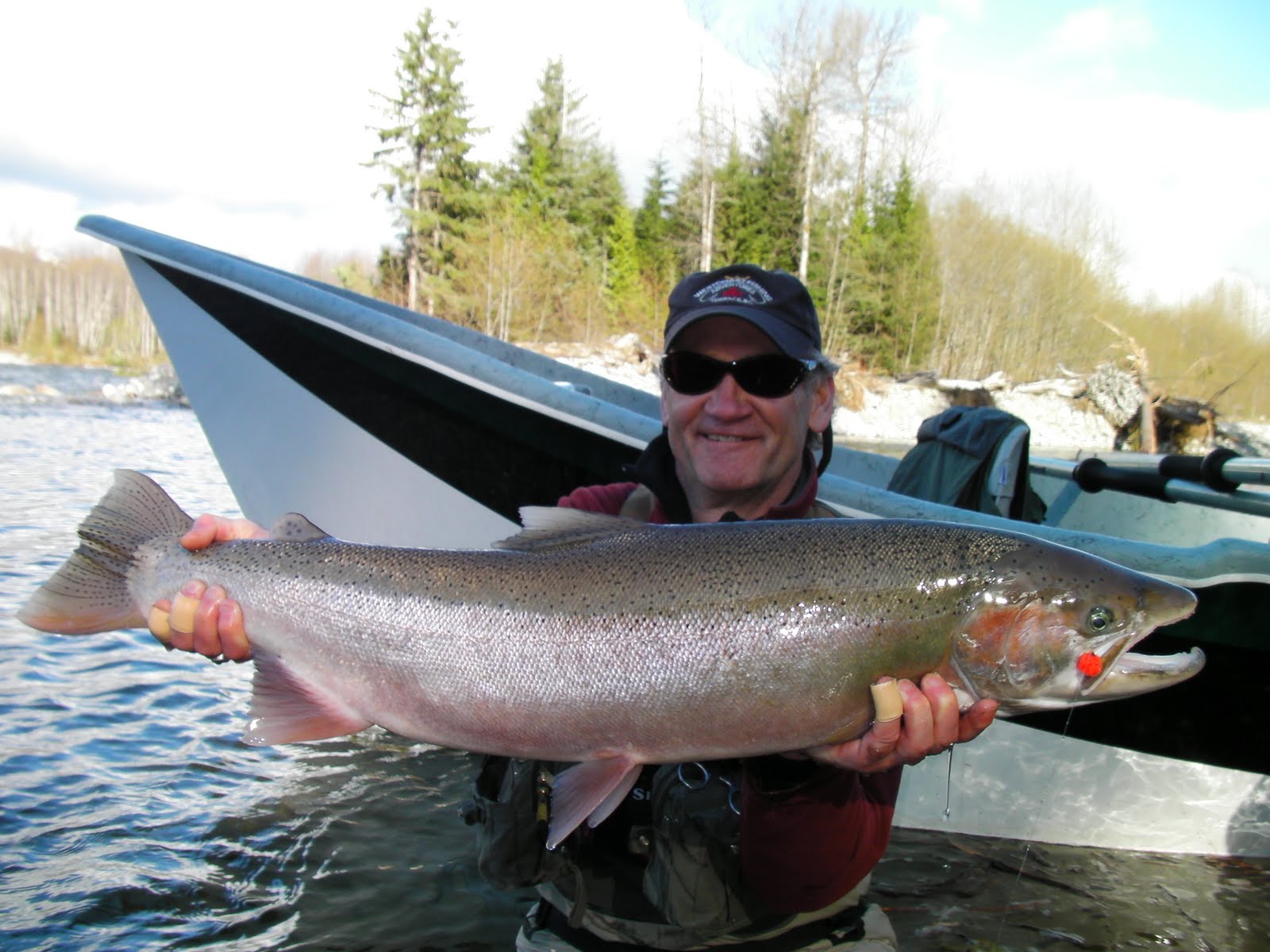
In the morning, we decided to drift the Zymacord. It had rained lightly the previous night and the river had risen some. As John and Gill got the rubber boat ready I cast into the pool near the boat and immediately hooked and landed a cutthroat trout. A few casts later, and a few feet downstream I was into the first steelhead of the trip, a feisty "buck" that refused to come in easily. We photographed it and then quickly launched the boat. Two pools down stream Gill took a second steelhead on the swing.


The day remained overcast with occasional light rain, and the river continued to rise and color-up. Gill had another hard strike at Salvation pool and I landed a second steelhead before the day was over. A much better day, and we were guardedly optimistic that conditions were improving.

We decided to go back to the Kitimat the following morning and drift from the highway bridge to Nalbeelah, a long drift. It was raining lightly when the boat slid into the river and the river had risen over a foot in the past 36 hours. John was the only one to have a hit all day, we expected better given the improving conditions. There was some speculation that fish in the river may have moved up into the tributaries with the rising water and the lower river was now muddy.

Gluttons for punishment, we returned to the Kitimat and the highway bridge the next morning. It was clear and sunny when we started. About a mile below the launch point I hooked a good fish. It first struck my strike indicator, then turned a 180 and nailed my orange egg. It was a heavy fish, we were drifting downstream a good clip and it decided to head upstream; I was quickly into my backing. Gill slowed the boat as much as possible as the fish continued upstream. Finally it turned and I slowly gained line as we looked for slower water. Now the fish was near the boat as we drifted further downstream. Gill worked the boat into still water near a side channel where I was able to get out of the boat. The fish tired slowly and after two attempts to tail it we had a wonderful "buck" in our hands.


Not far downstream John had big steelhead hit his strike indicator on two successive casts. We were now anchored near the middle of the river at the head of a series of rapids. I cast to the far bank and immediately hooked a good fish, which was holding off the bow of the boat. We decided to stay put and see if John could hook a second fish. But suddenly my fish turned downstream and I was quickly into backing. As line melted away we had no choice, but to chase my fish. As Gill pulled the anchor, the fish turned upstream and with the combination of the boat moving down, the fish moving up and a big belly of line, the fish was off. The moral to that story is: it doesn't pay to be greedy.

We had drifted about another mile when John hooked a good "buck". It too struck his strike indicator first and then his dead-drifted egg. We got out of the boat on the far bank. The fish made several strong runs before we were able to coral it.


John landed a another fish at the take-out point; a small spunky female. In all we landed four steelhead and had 4-5 other takes for the day.

It was back to the Zymacord the next day with Gordon as our guide. We bypassed the first two pools that were occupied when we got there. John hooked a small "buck" on the swing at the next pool. Then as we started into the next, narrow pool a heavy steelhead immediately took my egg pattern near the center of the bucket. The pool was short and narrow, but the fish didn't try to leave the pool and unexpectedly turned into some soft water; suddenly Gordon had an impressive "buck" in the net!


We continued downstream and at Salvation pool John hooked and landed a small "hen" and then Gordon, fishing clean-up, took a much bigger fish; both were bright and taken swinging flies.


We continued the drift downstream. There is fast section of water above Austen's hole. It is relatively wide and shallow with a trough along river left and then drops though a series of rapids and ends with a sharp bend to the left at the face of a rock wall. We drifted eggs along the left bank. In less than two feet of water and just as we were about to drift over the lip and into the rapids a steelhead rolled at my fly and I was hooked-up. As we slipped into the rapids the fish wanted to stay in the pool above. I was into my backing when the fish finally turned. We pulled ashore at the inside of the bend at the bottom of the rapids where I got out and finally landed a nice "buck". This was the last fish of the day, which included sun, wind, overcast and fresh snow on the mountain tops.


I decided to fish a sixth day with John and Darren, another guide; it was back to the Zymacord. The day started cold and sunny. We reached Salvation pool by noon without any fish, although we had a couple of takes. We fished the pool hard and finally Darren took a bright "hen" near the tail-out swinging a fly. By late afternoon, now overcast and raining lightly, I finally hooked a small, strong "buck" near the bank, not far upstream from the take-out. We approached a side-stream on river right and pulled over to wade the pool. It was wide and fairly deep with dark water. On my second cast I hooked a heavy fish on an egg pattern that turned out to be the only female I took on the trip, and the third largest fish. John hooked up with another good fish right behind me, but lost it. It was getting late and we soon pulled out of river for the last time on this trip. John would fly back to Colorado tomorrow and later that evening Darren drove me to Prince Rupert to catch the ferry back to Ketchikan. In the end, this turned out to be my best spring, BC steelhead trip yet. I later learned that the rivers dropped again and that fishing fell off the following week.

Sunday, January 31, 2010

Kvichak 2009 For Good or Evil

The usual suspects assembled at dawn, on Monday morning, in front of the Lake Clark Air terminal, at Merrill Field, in Anchorage. It was a smaller group this year, 2 of our party had flown into Igiogik the previous day by private plane, and 3 more would arrive on Wednesday. It was the third week of September and we were headed to the Kvichak in pursuit of rainbows. For good or evil, this was the third year in a row of this insanity.

It was dark and the office was still closed when we pulled into the parking lot, and so we waited in the car. Soon lights came on inside, the door opened and we quickly piled our gear in front of the scales for the “weigh-in”. Our cargo was soon loaded into the plane, followed by the three of us and finally the pilot. The plan was to fly through Lake Clark Pass, land at Port Alsworth on Lake Clark to pickup more freight – which had been shuttled there over the weekend – and then continue on to Igiogik, the point where the Kvichak River is born. We took off at first light.

We came in low over Igiogik, circled and landed. I could see Mike and Phil, who had flown in on Sunday, standing in front of the hangar, along with our host, George. The initial reports were not promising. The group ahead of us, very experienced on the river, declared the Kvichak a bust and moved over to the Naknek River. In spite of this and with blind optimism, we loaded our gear into the waiting boats and headed down river to Blueberry Island Lodge certain that our knowledge of the river would prove the previous party wrong.


At the lodge, we quickly unloaded the boats, had lunch, shook out our gear, and in two boats fanned out down river. The weather was sunny, cool and slightly windy. Our normal approach is to dead-drift beads, egg patterns and flesh flies, or swing black leeches, and large articulated flesh flies. I was armed with an 8’ 6”, 7-weight single handed rod, and a 10’ 6” 8/9-weight switch rod. After 2 hours of hard fishing we had little to show for our efforts and by the time we headed back to camp we had landed only a few rainbows. The disturbing thing was that we saw very few spawning reds (sockeye salmon) in the river, the normal target for foraging rainbows. We did see a large brown bear, up close and personal, near one of our favorite spots on the river, the first of several sightings over the ensuing days. In spite of the poor showing, we chalked it up to a first-day learning curve and remained enthusiastic.


After dinner that evening we poured over aerial photos of the braids, the group of islands where we concentrate our efforts. George offered some suggestions based on the past couple of weeks fishing. The braids consist of low, relatively flat, grass-covered islands formed by 4 or 5 main channels and numerous smaller streams of water that bisect the islands. Last year some of the smaller, back channels held a surprising number of large fish. Convinced that it was just a matter of time until we found the rainbows, we called it a night.

The next morning dawned cold, and the camp was without running water due to frozen waterlines. It was still dark when I pulled on my waders and frozen boots. Rods and day bags were loaded in the boats, and with the sun barely visible on the east we pulled away from camp and raced downstream into the biting air. There were two boats in our small flotilla; a third when the balance of the party arrived on Wednesday.

Again, the day started slow. The hot spots from last year were producing little, and in some cases, no fish at all. By noon, we were becoming discouraged. We had found a few fish near the inlets to some of the back channels. In one case, we actually got a double; but still few reds, and a fewer rainbows. The rest of our group flew in and were on the river by lunch; maybe they would have better luck.


We continued to catch just enough rainbows to keep us interested and to harbor thoughts that at some point we would find the Holy Grail, but that never happened. We caught a few fish in the 26-27 inch class. I managed to find a honey hole that produced several nice rainbows, including a fish-of-life-time. I had taken two fish and had a couple of other hits at the downstream edge of one of the inlets to a back channel; the point where the water falls off in two directions. The fish were lying in a hole very near the downstream bank. The moment the rainbow hit I knew it was a heavy fish. It started with slow, hard head shakes and an immediate downstream run, quickly stripping line from my reel. I had been swinging a black leech on my switch rod, the drag was set just right and line was melting off the reel effortlessly when suddenly it went limp and the fish made three jumps in rapid succession. It was a thick-sided rainbow, at least 30 inches. At first I thought the hook had come out, but when the leader came back the fly was missing. The rainbow had been jumping in an effort to throw the hook. The only explanation I have for the broken leader was a deeply swallowed fly and leader raked across a tooth.


The week ended as it had started, clear and sunny and with a few rainbows. Over 4 million reds passed through the counter near Lake Iliamna, but few stayed in the river. My theory is that the rainbows followed them into the lake and then into the many rivers that flow into it. There was good rainbow fishing in the Iliamna drainage in 2009, but the Kvichak was below normal in terms of the numbers of fish. The rainbows key on the reds and depend on their eggs and flesh to survive the winter. It is always great to spend a week on this river regardless of the number of fish we catch; be assured we will return.